Knee pain and early-stage arthritis are no longer problems limited to older adults. Increasingly, younger and active individuals are experiencing knee degeneration due to sports injuries, demanding lifestyles, previous trauma, or genetics.
This has led to a growing interest in partial knee replacement for younger patients as a joint-preserving alternative to traditional surgery.
With advancements in surgical techniques and implant design, many patients now ask: is partial knee replacement suitable for active patients?
This article explores that question in detail, with expert insight from Mr. Nikhil Pradhan, Senior Orthopaedic Consultant in the Northwest of the UK, specialising in hip, joint, and knee surgery for over 30 years.
Understanding Partial Knee Replacement (Unicompartmental Knee Replacement)
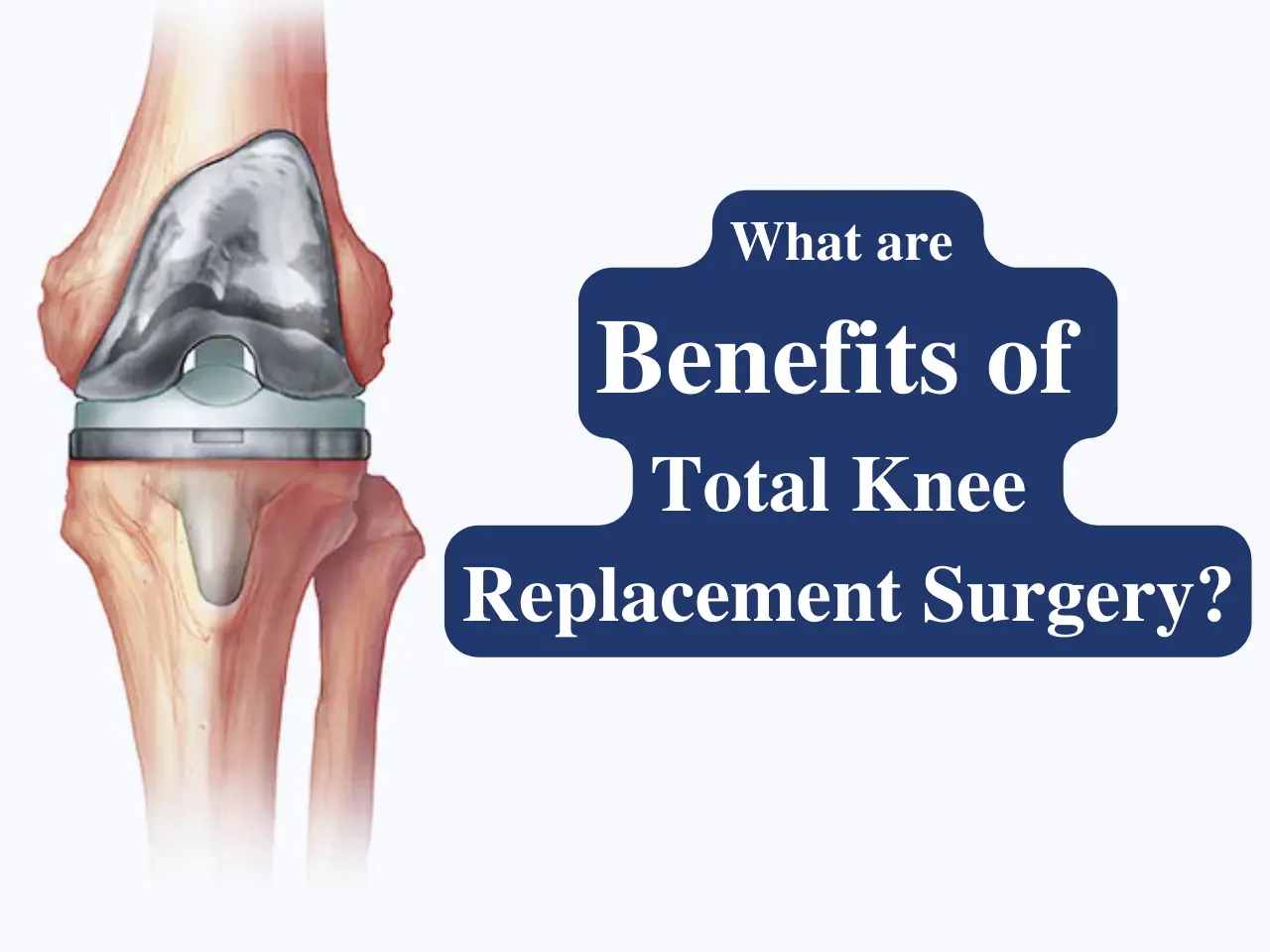
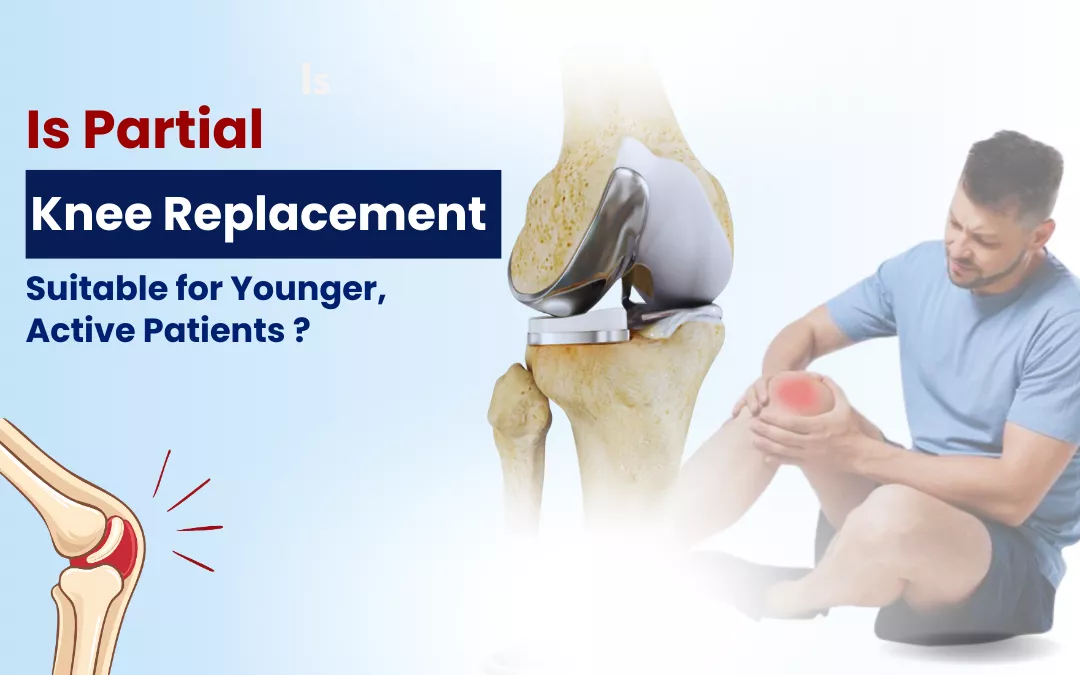
Partial knee replacement, also known as unicompartmental knee replacement, is a procedure where only the damaged portion of the knee joint is replaced.
Unlike total knee replacement, which resurfaces the entire joint, this surgery targets a single affected compartment—medial, lateral, or patellofemoral.
Key Characteristics
- Only the worn-out compartment is replaced
- Healthy bone, cartilage, and ligaments are preserved
- The knee retains a more natural feel and movement
This joint-preserving approach makes partial knee replacement increasingly attractive for knee replacement for young adults who want to stay active.
Partial vs Total Knee Replacement: What’s the Difference?
When discussing partial vs total knee replacement, the main difference lies in how much of the knee joint is replaced.
Partial Knee Replacement
- Smaller incision and less bone removal
- Faster recovery and less post-operative pain
- Better range of motion and natural knee function
Total Knee Replacement
- Entire knee joint is replaced
- Suitable for widespread arthritis
- Longer recovery time
For younger patients with arthritis limited to one compartment, partial replacement is often considered the best knee replacement option for young patients.
Why Younger, Active Patients Are Considering Partial Knee Replacement
Traditionally, surgeons hesitated to perform knee replacement surgery in younger individuals. Today, that mindset has changed.
Reasons for the Shift
- Improved implant durability
- Better surgical accuracy
- Higher success rates in carefully selected patients
For those seeking knee replacement for active lifestyle, partial knee replacement offers:
- Quicker return to daily activities
- Easier rehabilitation
- Preservation of future surgical options
This makes it particularly appealing for patients considering partial knee replacement under 50.
Is Partial Knee Replacement Suitable for Active Patients?
The short answer is: yes, in the right patients.
So, can active people get partial knee replacement? Absolutely—provided they meet specific clinical criteria. Partial knee replacement is often suitable for individuals who:
- Enjoy walking, cycling, swimming, or golf
- Want to maintain an active but sensible lifestyle
- Are willing to avoid repetitive high-impact sports
While it may not be ideal for professional athletes involved in high-impact sports, it works exceptionally well for patients aiming to stay mobile and pain-free.
Who Is a Candidate for Partial Knee Replacement?
Understanding who is a candidate for partial knee replacement is crucial for long-term success.
Ideal Candidates
- Arthritis limited to one knee compartment
- Stable ligaments (especially ACL)
- Good knee alignment
- Healthy body weight and bone quality
Who May Not Be Suitable
- Arthritis affecting multiple compartments
- Significant ligament instability
- Inflammatory arthritis such as rheumatoid arthritis
This careful selection process answers the common concern: is partial knee replacement good for young patients? When chosen correctly, the outcomes are excellent.
Partial Knee Replacement Under 50: What Younger Patients Should Know
Age alone does not determine suitability. Many patients under 50 have joint damage severe enough to affect quality of life but limited enough to avoid total replacement.
Key Considerations
- Overall knee health matters more than chronological age
- Early intervention may prevent further joint damage
- Partial replacement preserves bone for the future
For many, it truly becomes the best knee replacement option for young patients.
How Long Does Partial Knee Replacement Last in Young Patients?
One of the most common questions is: how long does partial knee replacement last in young patients?
Implant Longevity
- Modern implants often last 15–20 years or more
- Outcomes depend on:
- Activity level
- Body weight
- Surgical expertise
If revision surgery is required later, converting a partial knee replacement to a total knee replacement is usually simpler than revising a previous total knee replacement.
Recovery and Return to an Active Lifestyle
Partial Knee Replacement Recovery Time
Recovery is generally faster than total knee replacement:
- Walking within days
- Driving often possible within 2–3 weeks
- Return to work in 3–6 weeks (depending on job type)
Knee Replacement for Active Lifestyle
Patients commonly return to:
- Walking and hiking
- Cycling and swimming
- Golf and low-impact gym activities
High-impact sports may need to be limited, but most patients enjoy a pain-free, active life.
Partial Knee Replacement vs Total Knee Replacement: Long-Term Outcomes
In younger patients, partial knee replacement often results in:
- Higher satisfaction rates
- More natural knee movement
- Better functional outcomes
The surgeon’s experience plays a vital role in achieving these results, particularly with unicompartmental procedures.
Partial Knee Replacement in Cheshire: Why Specialist Care Matters
Choosing the right surgeon is critical. For patients considering partial knee replacement in Cheshire, specialist expertise ensures:
- Accurate diagnosis
- Proper patient selection
- Optimal implant positioning
Consulting a highly experienced partial knee replacement surgeon in Cheshire significantly improves long-term outcomes and patient satisfaction.
Expert Perspective: Mr. Nikhil Pradhan
With over three decades of orthopaedic experience, Mr. Nikhil Pradhan focuses on personalised treatment plans that prioritise joint preservation, function, and long-term quality of life—especially for younger and active patients.
Frequently Asked Questions (FAQs)
Is partial knee replacement good for young patients?
Yes, when arthritis is limited to one compartment and the patient is carefully selected, outcomes are excellent even in younger individuals.
Can active people get partial knee replacement?
Yes. Patients with active lifestyles can benefit greatly, especially if they engage in low- to moderate-impact activities.
How long does partial knee replacement last in young patients?
Most modern implants last 15–20 years or longer, depending on activity level and overall health.
What is the recovery time for partial knee replacement?
Partial knee replacement recovery time is typically faster than total knee replacement, with many patients resuming normal activities within weeks.
Is partial knee replacement better than total knee replacement?
In suitable cases, partial knee replacement offers better knee function, faster recovery, and a more natural feel compared to total knee replacement.
Conclusion
So, is partial knee replacement suitable for younger, active patients? For the right candidate, the answer is a confident yes.
With proper evaluation, expert surgical care, and realistic expectations, partial knee replacement offers younger patients a durable, effective solution that supports an active and pain-free lifestyle.