
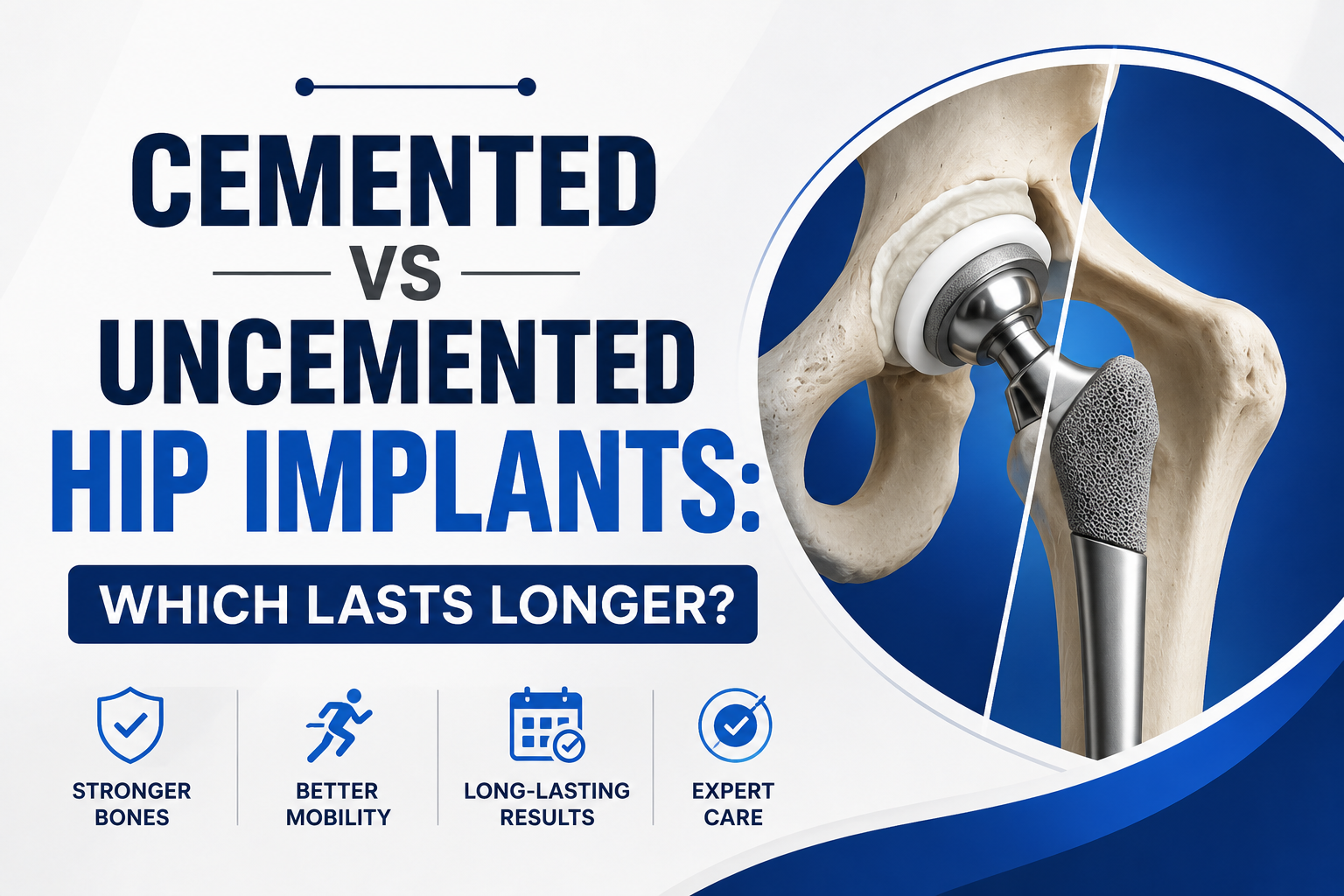
Hip pain caused by arthritis, fractures, or joint degeneration can significantly affect your quality of life. When conservative treatments such as medication, physiotherapy, or injections no longer provide relief, hip Replacement surgery may be the most effective solution for restoring mobility and reducing pain.

One of the most common questions patients ask before surgery is whether they should choose a cemented or uncemented hip implant. Both options have excellent success rates, but the right choice depends on factors such as age, bone quality, activity level, and overall health.
At Cheshire Hip and Knee Clinic, every patient receives a personalised treatment plan based on their individual needs. As a Best Hip Replacement Specialist serving patients in Cheshire, the focus is on selecting the implant that offers the best long-term outcome, improved mobility, and lasting pain relief.
What Is Hip Replacement Surgery?
Hip Replacement surgery is a procedure that replaces damaged parts of the hip joint with artificial components called prosthetic implants. These implants are designed to restore smooth joint movement, reduce pain, and improve everyday function.
The procedure is commonly recommended for patients with:
- Osteoarthritis
- Rheumatoid arthritis
- Hip fractures
- Avascular necrosis
- Severe hip joint damage
- Chronic hip pain affecting daily activities
Modern hip replacement techniques have transformed the lives of millions of patients, allowing them to return to walking, exercising, and enjoying an active lifestyle.
Understanding Hip Implants
A hip implant generally consists of four components:
- Femoral stem
- Femoral head (ball)
- Acetabular cup (socket)
- Liner
The major difference between implant types lies in how the implant is fixed securely to the bone.
The two primary options are:
- Cemented hip implants
- Uncemented (cementless) hip implants
What Are Cemented Hip Implants?
Cemented implants are secured to the bone using a special medical-grade bone cement. This cement hardens quickly, creating immediate stability between the implant and the bone.
Advantages of Cemented Hip Implants
- Immediate implant fixation
- Excellent stability after surgery
- Suitable for patients with weaker bones
- Lower risk of early implant movement
- Proven long-term clinical success
These implants are commonly recommended for older patients or those with osteoporosis, where bone quality may not be strong enough for natural bone growth around the implant.
What Are Uncemented Hip Implants?
Uncemented implants are specially designed with porous surfaces that encourage the patient’s natural bone to grow into the implant over time.
Instead of bone cement, the implant becomes permanently fixed through biological bone integration.
Advantages of Uncemented Hip Implants
- Natural bone growth creates long-term fixation
- Ideal for younger and active patients
- Excellent durability
- Easier revision surgery in some cases
- Reduced dependence on bone cement
Although recovery may initially take slightly longer while the bone integrates with the implant, long-term outcomes are excellent in appropriately selected patients.
Cemented vs Uncemented Hip Implants: Key Differences
| Feature | Cemented Implant | Uncemented Implant |
| Fixation Method | Bone cement | Natural bone growth |
| Initial Stability | Immediate | Develops over time |
| Best For | Older adults | Younger, active patients |
| Bone Quality Required | Lower bone density | Strong, healthy bone |
| Recovery | Immediate stability | Gradual biological fixation |
| Longevity | Excellent | Excellent |
Both implant types have outstanding long-term success when chosen for the right patient.
Which Hip Implant Lasts Longer?
One of the biggest concerns patients have before hip Replacement surgery is implant longevity.
Thanks to advances in implant materials and surgical techniques, both cemented and uncemented implants can last 15 to 25 years or longer. Many patients continue to enjoy excellent function beyond this period.
Rather than focusing solely on whether an implant is cemented or uncemented, longevity depends on several important factors, including:
- Surgical technique
- Implant positioning
- Bone quality
- Patient activity level
- Weight management
- Rehabilitation
- Overall health
Choosing an experienced best hip replacement specialist is often more important than the fixation method itself.
How Do Surgeons Decide Which Implant to Use?

There is no one-size-fits-all approach to hip replacement.
A specialist carefully evaluates several factors before recommending the most appropriate implant.
These include:
Age
Younger patients generally benefit from uncemented implants because their stronger bones can grow into the implant naturally.
Bone Quality
Patients with osteoporosis or reduced bone density often receive cemented implants for immediate stability.
Activity Level
Active individuals who participate in sports or regular exercise may be better suited for uncemented implants.
Overall Health
Medical history, lifestyle, and other health conditions all influence implant selection.
At Cheshire Hip and Knee Clinic, every surgical plan is tailored to the individual patient to achieve the safest and most durable outcome.
Recovery After Hip Replacement Surgery
Recovery varies depending on the patient’s health and the type of procedure performed.
Most patients can expect:
- Walking within a day after surgery
- Physiotherapy beginning soon after the procedure
- Gradual return to daily activities within several weeks
- Continued improvement over several months
Following your surgeon’s rehabilitation programme plays a crucial role in ensuring the implant functions well for many years.
Why Choose Dr. Nikhil Pradhan in Cheshire?
Selecting the right surgeon is one of the most important decisions before undergoing hip Replacement surgery.
Patients choose Dr. Nikhil Pradhan because of:
- Expertise in modern hip replacement techniques
- Personalised treatment plans
- Comprehensive pre-operative assessment
- Advanced surgical technology
- Patient-focused rehabilitation
- Commitment to achieving long-term mobility and pain relief
As a Best Hip Replacement Specialist in Cheshire, Dr. Nikhil Pradhan works closely with each patient to determine the most suitable implant based on their unique needs and lifestyle.
Conclusion
Both cemented and uncemented hip implants offer excellent long-term results when matched to the right patient. While cemented implants provide immediate stability and are often preferred for older adults with weaker bones, uncemented implants promote natural bone growth and are commonly recommended for younger, active individuals.
The success and longevity of hip Replacement surgery depend not only on the implant itself but also on careful patient assessment, precise surgical technique, and proper rehabilitation.
If you are considering hip Replacement surgery in Cheshire, consulting an experienced Best Hip Replacement Specialist can help you understand your options and choose the implant that best supports your long-term mobility, comfort, and quality of life.
At Cheshire Hip and Knee Clinic, every treatment plan is designed to deliver safe, personalised, and lasting outcomes, helping patients regain confidence and return to the activities they enjoy.
Frequently Asked Questions (FAQs)
1. Which is better, a cemented or uncemented hip implant?
Neither option is universally better. The choice depends on factors such as age, bone quality, activity level, and overall health. Your surgeon will recommend the most suitable implant for your needs.
2. How long does a hip replacement implant last?
Modern hip implants often last 15 to 25 years or more, depending on the implant type, surgical technique, patient lifestyle, and rehabilitation.
3. Who is a good candidate for an uncemented hip implant?
Younger, active patients with strong bone quality are typically good candidates because their bone can naturally grow into and secure the implant.
4. Is recovery different between cemented and uncemented hip replacements?
Cemented implants provide immediate stability, while uncemented implants rely on bone growth over time. However, both approaches generally have excellent recovery outcomes when patients follow their rehabilitation programme.
5. Why should I choose a specialist for hip replacement surgery in Cheshire?
An experienced Best Hip Replacement Specialist offers accurate diagnosis, personalised implant selection, advanced surgical techniques, and comprehensive aftercare, all of which contribute to better long-term results and improved quality of life